Case Facts: Ernesto Miranda was arrested and locked up in a Phoenix police station on March 13, 1963 where he was identified by a complaining witness (Samaha, 2012). Law enforcement officers took him to an Investigation Room where he was questioned before the two officers came out with a written confession that he signed. During the questioning, Miranda was not notified that he had a right to an attorney and was notified of the need for voluntary confession after making his oral confession. The written confession was then admitted into evidence at his trial before a jury despite objections from the defense counsel. The court then found him guilty of kidnapping and rape and sentenced him to 20 to 30 years in prison for each count, with these sentences running simultaneously. This ruling was upheld by the Supreme Court of Arizona following Mirandas appeal on the basis that his constitutional rights were not violated since he did not specifically request counsel.
Issue: The issue was whether police officers should notify arrested defendants of their constitutional rights against self-incrimination under the Fifth Amendment to the U.S. Constitution before interrogation.
Arguments or Objectives of the Parties: The defense counsel representing Ernesto Miranda objected the admission of the...
This argument was based on the fact that police officers admitted that they did not advice Miranda of his right to an attorney and read out his right to voluntary confession prior to obtaining an oral confession from him. Therefore, the objective of the defense counsel was to stop the admissibility of the written confession into evidence. On the contrary, the State of Arizona contended that Mirandas Fifth Amendment Constitutional rights were not violated because he did not specifically request counsel. This argument was made to help ensure that the written confession was utilized as evidence to incriminate Miranda for his crime.
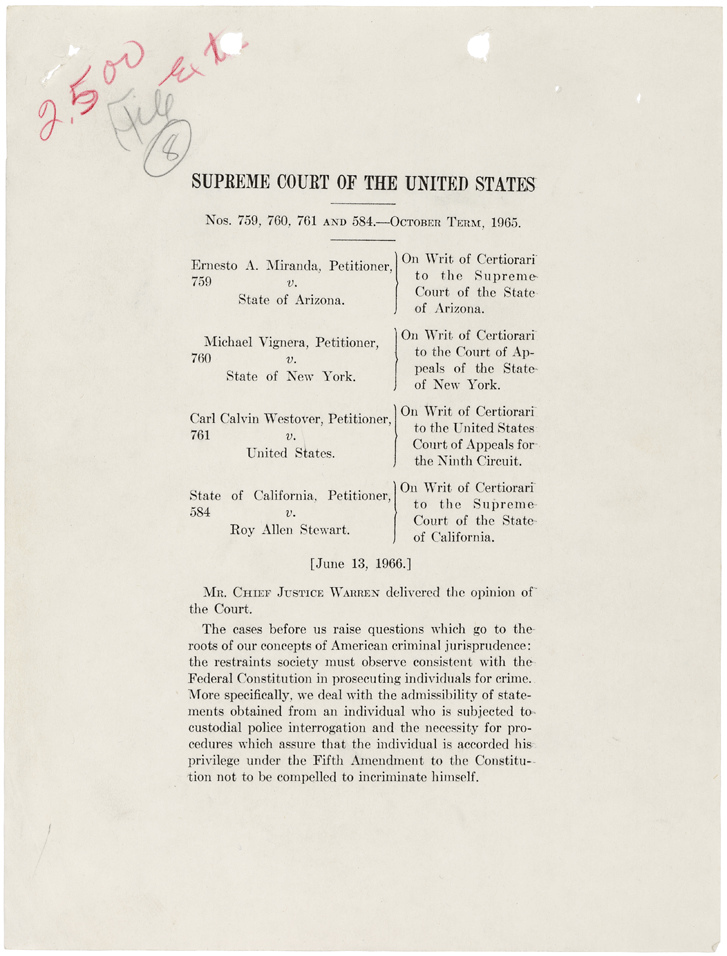
Holdings: In a split 5-4 decision, the Supreme Court ruled that law enforcement officers need to advice arrested persons of their Fifth Amendment constitutional rights before interrogation. Arrested individuals need to be notified of their right to remain silent, right to have an attorney or counsel appointed to represent them, and an explanation that any utterances could be used against them in a court of law. The absence…


